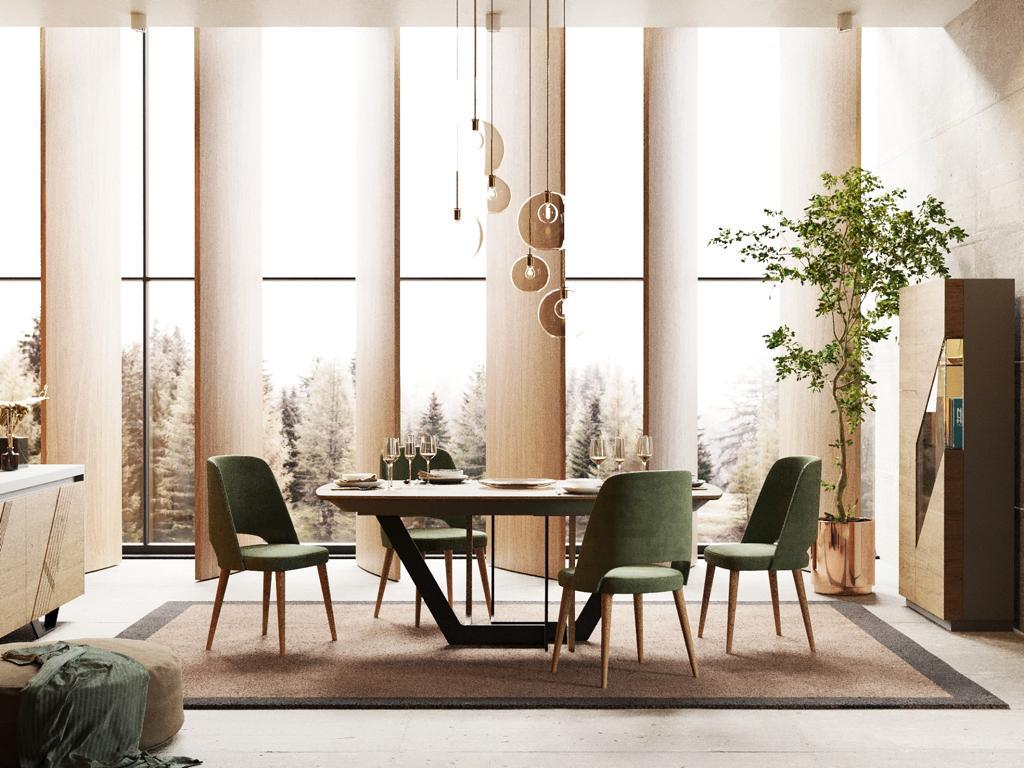
A client came into the Armação de Pêra showroom with the length of her dining room written on the back of her hand. Four metres twenty. She had already picked a dining table of two metres forty, which left plenty of room, on paper.
At home, the sideboard took forty-five centimetres off one side and the kitchen door swung into the other. She had measured perfectly; nobody measures a door swing. We only do it because we have seen it catch people out more than once.
Selecting a dining table starts with the chairs. Allow about 60 centimetres of edge for each person, and roughly 90 centimetres clear between the table and the nearest wall or sideboard, so one person can pull a chair back while another gets past with a dish. Measure that space first; the table is whatever fits inside it.
Legs, and who ends up sitting on them
Shape gets most of the attention in the showroom and legs get almost none, though the legs decide how many people actually fit. A rectangular top with a leg at each corner seats the number on the label. Put the same top on a central pedestal, or on two trestles set in from the ends, and two more fit at Christmas without anyone straddling wood.
Round tables are kind to conversation and to awkward rooms, up to a point. Past six people the middle becomes a place nobody can reach, and the salt has to travel. Oval keeps most of that ease in a room longer than it is wide, which describes plenty of Algarve apartments where the dining end shares space with the sofa; drawing that line is the subject of our piece on open-plan living rooms.
Then the chairs, again. Armchairs at the ends look generous and need a table whose apron (the frame just under the top) sits high enough for the arms to slide beneath it. Many don’t. You find out the first evening, when two chairs stay a hand’s width from the table all night.
Eleven months for two, August for twelve
This is the part people most often get backwards here. A house in the Algarve spends most of the year with two or three at the table, and then the family arrives, or the friends from abroad, and for three weeks there are twelve.
A table for twelve used by two looks like a canteen in February. An extending table bought at the everyday size is almost always the better answer, as long as the mechanism is one you can work alone; some need two people and a free afternoon, so ask to open it yourself in the showroom. And for the one dinner a year that outgrows even the extension, the terrace table takes the overflow, which is a good argument for buying the garden furniture at the same height as the dining set.
Holiday rentals push all of this further. Guests rarely count chairs before booking, but they always count them on arrival, and a table that seats the number in the listing without the extension matters more to an owner than any finish. What else survives a summer of lets is in our notes on furnishing a holiday rental.
The top, the sun and the lemons
Solid wood moves. It shrinks a little in a dry August and swells in a damp January, and a well-made top is built to let it; a split along the grain usually means it wasn’t. Sun through a big glass door will also colour one end of a wooden table differently from the other within a couple of years, which some owners love and others solve with a runner.
Marble is beautiful and does not forgive lemon juice. By the time the plates are cleared the stain is in the stone. For a table that has to take everything, a ceramic or sintered stone top is the safer choice, because a hot pan or a glass of red leaves nothing behind. Glass is easy to clean and hard to keep looking clean, especially in the low winter sun.
What surrounds the top counts as well. A rug under the table has to stay under the chairs when they are pulled out, as we explain in how to choose a rug, and a pendant hung too high lights the ceiling instead of the food, which the piece on lighting goes into. Looking after wood and stone from one year to the next is covered in our furniture care notes.
Sitting at it before you buy it
At H&P Mobiliário e Decoração we would rather you spent twenty minutes sitting at a table than two minutes looking at it. Bring the chairs you already own, if they are staying. Then get the tallest person in the family to sit down and check their knees against the apron, while somebody else leans on one corner to see whether it rocks.
When nothing in the dining room collection suits the room, a top can be made to measure, down to the centimetre the kitchen door leaves you. Both showrooms, in Albufeira and Armação de Pêra, have tables set up with chairs around them for this; come and pull one out. Bring the measurements on your hand if you like. Include the door.
