How to choose a rug is something most people only figure out too late. The rug arrives. You unroll it. The room looks worse.
Not dramatically worse. Just wrong in a way you can’t name immediately. You measure again. The numbers are fine. And yet.
The reason is almost never the rug. It’s the decisions that led to buying it, and most of those decisions were made while looking at a price tag rather than a floor plan.
Rugs are expensive. That’s the honest explanation for why most people buy them too small. The gap between a rug that fits a living room properly and one that almost fits is real money, and in a shop or scrolling online, slightly-too-small looks like it might work out. It doesn’t. The sofa and chairs end up hovering around a rug that covers the coffee table and nothing else, and the whole arrangement looks provisional, like something temporary that was never resolved. You put money and thought into a room and the rug makes it look like you didn’t.
Measure the seating area first. Not the room. The actual footprint of the furniture. Then go one size up from whatever feels like enough.
For most living rooms in Algarve homes that means starting at 200 x 290 cm. Larger rooms or L-shaped sofas typically need 230 x 340 cm or more. The front legs of the sofa and every chair belong on the rug. Back legs off is fine and expected. But if the front legs aren’t anchored to it, nothing looks deliberate regardless of what you spent. Mark out the dimensions in painter’s tape before ordering anything. Sit in the space. Ten minutes and it tells you more than any amount of measuring on paper.
Open-plan layouts, which is most newer Algarve builds and the majority of holiday properties, add another layer to this. The rug isn’t just decoration in those spaces. It’s what tells the eye where the living area is. Without it doing that job properly, the seating reads as furniture placed in a large room rather than a room within a room. No amount of good furniture fixes an undersized rug in an open-plan layout.
The dining room has one rule and it’s not negotiable
The chair legs catch the edge every time someone sits down or stands up. You hear it, feel it through the chair, it happens a dozen times a day, and within a week it’s the most irritating thing in the house.
Sixty centimetres beyond the table on every side. A table of 160 x 90 cm needs a rug of at least 280 x 210 cm. Most people look at that number and assume something’s gone wrong. Nothing’s gone wrong. If the room can’t fit a rug that size, the honest answer is that the dining room rug might not be the right choice for that room. A rug that causes a problem every day is worse than no rug.
Bedrooms are more forgiving and the brief is simpler: the rug is there for what you land on when you get out of bed, not for how the room photographs. It belongs under the lower two-thirds of the bed, extending about 55 centimetres on both sides. For a standard double, 160 x 230 cm as a minimum. Two runners rather than one large rectangle is a legitimate alternative and sometimes looks more considered than a single piece.
What the Algarve does to your material choices
Most rug advice is written for climates that aren’t this one. Strong direct sun for most of the year, dust, tile and stone floors, frequent cleaning, and if it’s a holiday property, a level of seasonal wear that a delicate material simply won’t survive.
Wool is what holds up. It handles heat without deteriorating, it resists wear, and it cleans the way it should when something gets spilled. More expensive upfront. Not more expensive over five years.
Jute looks right here and works well in covered terraces and rooms that don’t take much traffic. The problem is that it absorbs moisture and doesn’t release it cleanly, which matters near exterior doors in winter and in any space where wet feet get tracked through. Don’t use it there. Flatweave and low-pile for anywhere that takes heavy use or gets cleaned often. They lie flat on tile, don’t trap dust, and don’t create the catching hazard that thicker rugs cause underfoot.
For holiday homes and rental properties specifically: synthetic rugs have improved to the point where this is a real conversation worth having. A jute rug that can’t survive the realities of a rental isn’t a good investment whatever it looks like. A synthetic that lasts a decade and cleans with a hose is.
Leave 30 to 50 centimetres of bare floor between the rug and the wall on all sides. Less than that reads as carpet that ran out of budget. Be consistent with how furniture legs sit on it — one chair on and one off looks accidental, all handled the same way looks chosen. In a long narrow room, run the rug lengthwise or it will cut the room in half rather than lead the eye through it. A large natural fibre base with a smaller decorative rug layered on top is a proper technique, not a workaround: it means the decorative layer can change without replacing the whole thing.
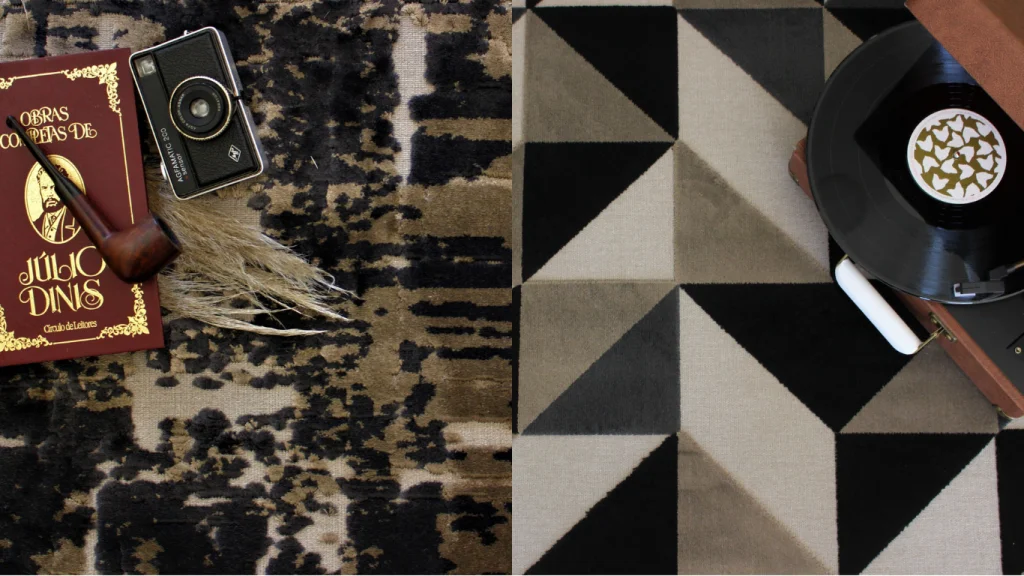
Come into the showrooms in Albufeira or Armação de Pêra with the measurements of the seating area and the distance from that footprint to each wall. Much of this becomes clearer with an actual rug in front of you than with numbers on a screen.


