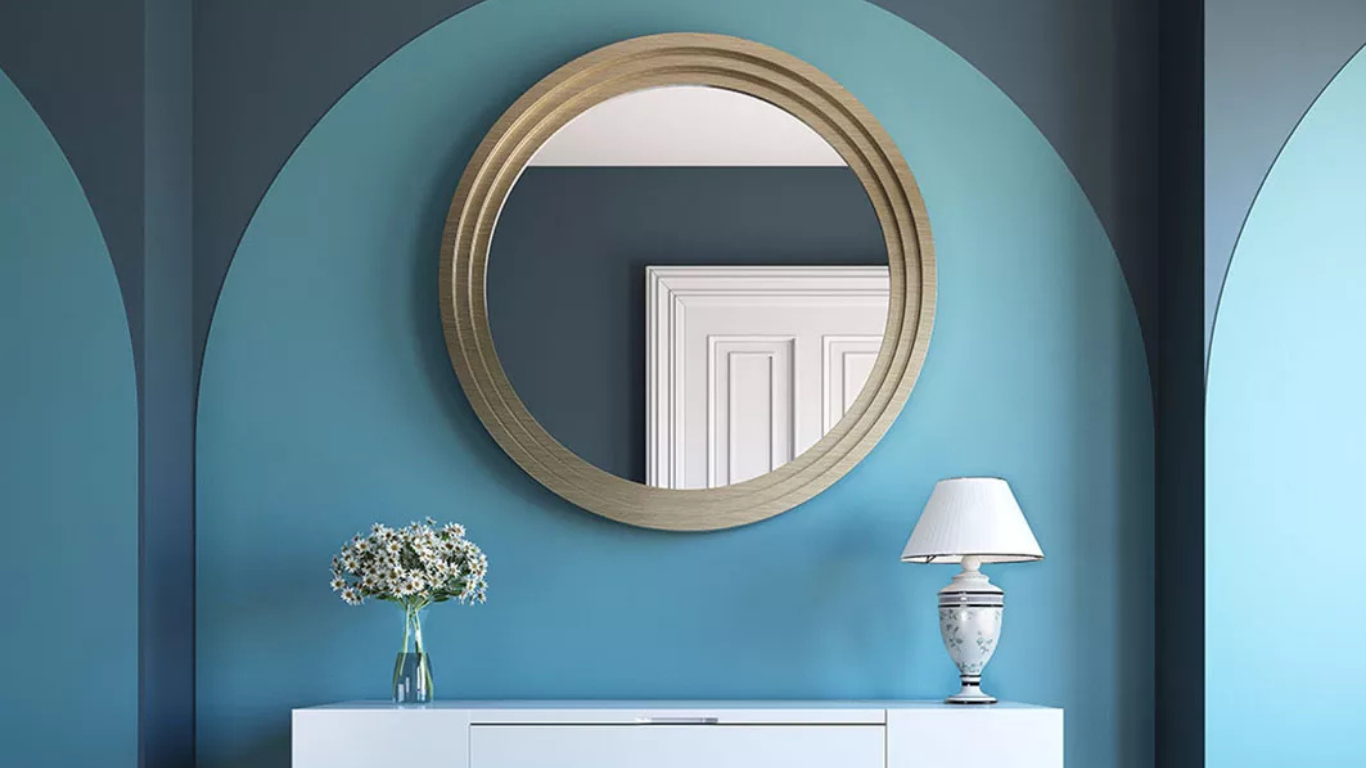
There’s a room we keep seeing. Different house, different client, different furniture — but the same problem. It’s not dark, it’s not cluttered, the proportions aren’t terrible. It just feels smaller than it is. And the instinct is always to start moving things around, swapping out a sofa, repainting.
Nine times out of ten, the actual fix is a mirror.
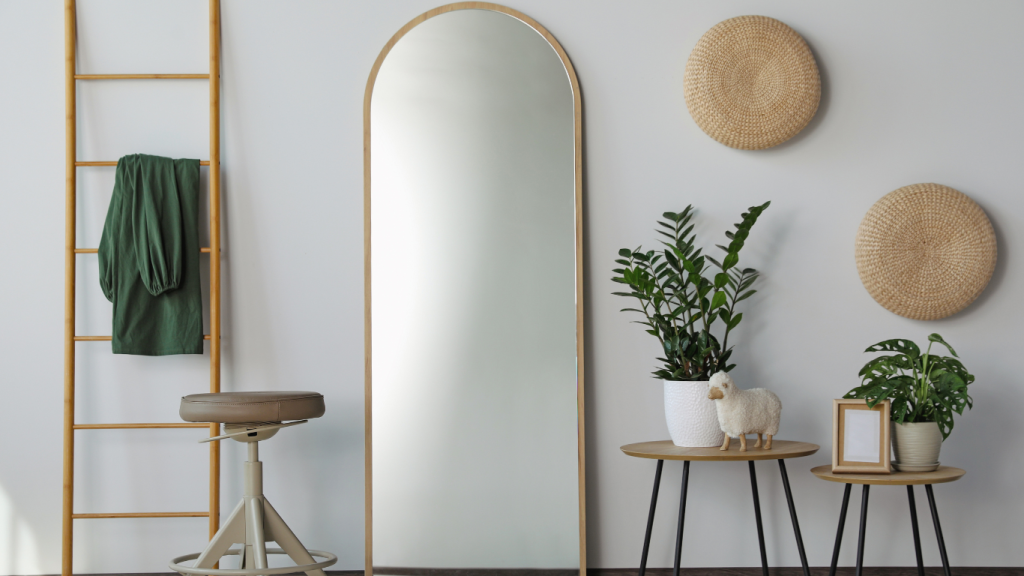
Not a decorative afterthought leaned against a wall. A properly placed, properly sized mirror treating the room as an optical problem to be solved. Using mirrors to enlarge space isn’t interior design folklore — there’s something genuinely perceptual happening. Your brain doesn’t register a reflection as a reflection. It reads the image as real depth, real square footage beyond the glass. A mirror opposite a window doesn’t just bounce light around; it gives the room what effectively reads as a second source of natural daylight. That changes everything.
We’ve seen this work in one-bedroom apartments in Albufeira where the living area was barely functional, in Algarve holiday villas where clients wanted an airier feel without touching the architecture, in dining rooms that seated four people comfortably but felt like they seated two. The mirror was the answer in most of them. Not the whole answer, but usually the most important part.
Why It Actually Works (The Perceptual Bit)
Your visual system is making constant guesses about depth and distance. When you glance at a mirror, it doesn’t file that image under “reflection.” It files it under “space over there.” So a 3-by-3 metre bedroom with a large wall mirror doesn’t feel like a 3-by-3 bedroom anymore. The brain has been handed extra information — a perceived room beyond the glass — and it adjusts its sense of the whole space accordingly.
Light responds similarly. Mirrors don’t create it, but they redirect it. A single north-facing window that normally lights half the room suddenly has its output sent back across the whole space. In rooms that rely entirely on artificial lighting, positioning a mirror to face the main lamp turns one source into what effectively feels like two. The room gets brighter. Brighter rooms consistently read as larger. That’s two problems solved with one piece of décor, which is a fairly good return.
Placement Techniques for Maximum Impact
The rule that overrides everything else: put your mirror opposite a window. Natural light hits the glass and doubles back across the room. The view outside appears twice. The space starts to feel connected to the exterior in a way that nothing else replicates. We give this advice to every client without exception, and it holds up every time.
The one caveat worth mentioning — if direct afternoon sun will hit that position for hours at a stretch, find a slightly different angle. Sustained glare isn’t pleasant to live with, and it can gradually break down the silver layer behind the glass.
Beyond that primary rule, two mirrors on facing walls create a repeating reflection that stretches narrow spaces visually — hallways, tight dining rooms, entrance corridors where width is the problem. It’s effective, but it demands clean glass. Everything in that reflected tunnel multiplies, including smudges.
The floor-to-ceiling approach is where clients are most often hesitant and most often wrong to be hesitant. A small mirror on a big wall reads worse than no mirror — it just highlights the bare wall around it. A mirror that runs the full height of your longest wall does something fundamentally different. Low ceilings read taller. The room stretches in the direction you need most. If you’ve been considering it and talking yourself out of it, come and look at how we’ve installed them in the showroom. It’s easier to see than to explain.
Going Room by Room
Living rooms — a large mirror above the sofa is one of the most reliable tricks in residential interiors. It adds depth behind the seating area without touching anything else. Floor mirrors leaned at an angle rather than hung flat do something slightly different; the angled reflection layers the room in a way that’s hard to describe but immediately obvious in person. Mirrored coffee tables work too, as long as you’re realistic about keeping them clean.
Bedrooms — mirrored wardrobe doors are the practical favourite. The space-enlarging effect happens without any effort, and you get the full-length view as a bonus. If you’re adding a standalone mirror, position it to catch the window. Morning light in a bedroom has an outsized effect on how the whole room feels to wake up in, and a mirror that captures it is one of the better things you can do for a space you spend time in every day.
Kitchens — a mirrored backsplash protects the wall behind the hob while making the work zone look considerably deeper. In a kitchen-diner layout, a mirror on the dining side adds something harder to name — a sense that the space is generous enough for a proper meal, not just a functional eat-in area. Small detail. Real effect.
Bathrooms — extend the mirror wider than the vanity, or put a second one on the opposite wall. The cross-reflection adds perceived space and makes shared morning routines substantially less fraught.
On Choosing the Mirror Itself
Ornate frames are worth considering when the room can actually absorb them. The mistake we see regularly: a beautiful frame around a mirror that’s too small to do anything useful. The decoration and the function have to work in the same direction. A stunning frame around a modest mirror is just a decoration. A stunning frame around a large mirror is something else entirely.
Simple metal or wood frames — brushed nickel, bronze, natural oak — split the difference reasonably well. They work with most interiors and don’t force a commitment to a particular aesthetic. Useful when you want the warmth of a frame without locking yourself in.
Common Mistakes to Avoid
While mirrors to enlarge space offer tremendous benefits, certain placement mistakes can diminish their effectiveness. Avoid positioning mirrors where they reflect clutter or unattractive views, as this multiplies visual chaos rather than creating calm spaciousness. Similarly, mirrors placed too high or too low may not capture optimal light angles or may create awkward reflections.
Another common error is using mirrors that are too small for the space. Undersized mirrors can make rooms feel smaller rather than larger, as they fail to create the necessary visual impact. When in doubt, choose larger mirrors rather than smaller ones for space enhancement purposes.
Light, and When to Think About It
This is worth considering before you decide on placement rather than after. Bedrooms usually catch morning sun. Living rooms tend to be at their best in the afternoon. Dining areas often have their best light in the evening. If you position your mirror to capture a room’s peak light moment, you’ll notice the difference daily without ever consciously clocking why.
In rooms with almost no natural light, point a mirror at your best lamp. The effect on perceived brightness is immediate — you’ve effectively doubled that light source without adding a single fixture or running any new wiring.
The Mistakes Worth Avoiding
Reflecting clutter. Before committing to a position, stand where the mirror will hang and look at exactly what it’ll show. A messy desk doubles. An unloved corner doubles. Mirrors don’t editorialize — they show you what’s there. Make sure what’s there is worth seeing twice.
Going too small. The instinct to choose something modest tends to work against you with mirrors specifically. Wall mirrors for small spaces need to cover at least a third of the wall to make a real difference. When torn between two sizes, the larger one is almost always correct. This is the piece of advice clients are most sceptical of and most frequently thank us for later.
Hanging at the wrong height. Centre the mirror between 145 and 165 centimetres from the floor — that’s eye level for most adults. Higher than that and you’re reflecting ceiling. Lower and you’re reflecting floor. Neither is useful. For full-length mirrors, leave 15 to 30 centimetres between the bottom edge and the floor.
Before You Drill Anything
Large mirrors are considerably heavier than most people anticipate. Decorative wall mirrors commonly run between 10 and 25 kilograms. Larger architectural pieces go well beyond that.
The hardware needs to match the weight — and then exceed it. As Lowe’s notes in their mirror installation guide, fixings should always be rated for the mirror’s actual weight, and industry practice is to choose anchors rated for at least double that figure to account for load stress and vibration over time.
At H&P we’ve seen what happens when this gets skipped. Damaged plaster is the most common outcome. Occasionally broken glass. For any mirror of real size or value, professional installation is genuinely worth the cost — not because hanging a mirror is complicated, but because wall types, fixing methods, and load ratings aren’t always obvious, and the consequences of getting it wrong aren’t trivial.
One more practical note: mirrors in hallways and bathrooms need cleaning about once a week. Elsewhere you can go longer. A mirror you won’t actually maintain will start working against the room eventually, so it’s worth being honest with yourself about that before you decide where it goes.
The underlying point is simple. Using mirrors to enlarge space costs far less than almost any structural or renovation alternative, requires no permits, and when done right, changes a room the same afternoon. The investment is mostly in choosing well and placing thoughtfully.
Questions We Get Asked Often
What size mirror actually makes a difference? Sixty centimetres on the shortest side is a minimum. Bigger is reliably better. The mirror should cover roughly a third of the wall it’s on — which feels counterintuitive to a lot of people, but it’s what actually produces the effect. Small mirrors on large walls read as decoration, not space enlargement.
Is it possible to overdo it with mirrors? Yes. One or two large mirrors per room is the working range for most spaces. Past that, the effect stops reading as “spacious” and starts reading as disorienting — less hotel lobby, more funhouse. The goal is depth, not infinity.
How high should a mirror be hung? Centre point between 145 and 165 centimetres from the floor. That’s eye level for most people and where a reflection is actually useful. For full-length pieces, 15 to 30 centimetres of floor clearance at the bottom.
What about rooms with no windows? Mirrors still work. They just redirect artificial light instead of natural light. The key is pointing them at your light sources rather than at a dark wall. Aim a floor mirror at your main lamp and the difference in the room’s brightness is visible almost immediately.Frameless or framed for a small room? Frameless, almost always. Nothing competing with the reflective surface, no visual complexity added to a space that’s already limited. Frames work well when there’s room to accommodate them — in genuinely small spaces, they tend to make things feel busier rather than better.
Source: Lowe’s, “How to Hang Heavy Mirrors” (lowes.com). Accessed 2026. For installation weight guidance, always consult manufacturer specifications and local building regulations.

'/%3E%3C/g%3E%3Cuse%20href='%23c'%20transform='matrix(-1%200%200%201%20720%200)'/%3E%3C/svg%3E)
'/%3E%3C/svg%3E)