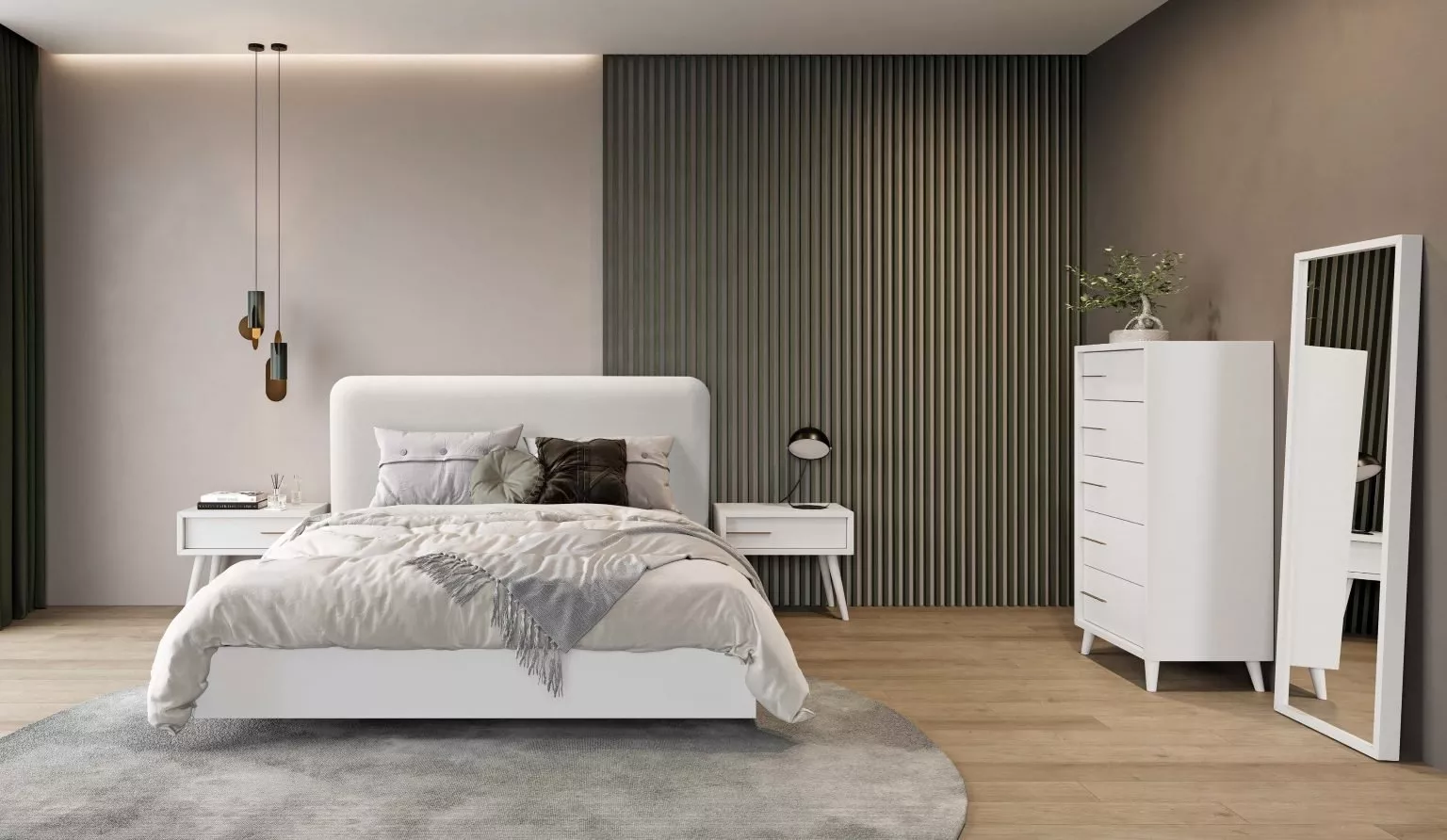
There is a scene we get to watch most weeks in the showroom. A couple stops in front of a bed. Forty minutes follow on the headboard fabric, whether the grey is too blue, whether linen is worth the creasing. Then one of them lies down, says the mattress seems fine, and the biggest decision in the room is over in four minutes.
We rarely interrupt. But a couple’s bedroom is the one room in a house designed by a committee of two, and after enough years of watching the committee work, you notice things. The rooms that go wrong almost never go wrong through bad taste. They go wrong through two good tastes cancelling each other out until the result belongs to nobody. The couples who end up with a bedroom they both love tend to have settled, knowingly or not, on a handful of the same arrangements. Collected here.
Someone has to win the wallpaper argument
Give both people equal say over every object and the room drifts toward the middle of everything. Middle colours, middle furniture, middle feelings about the result. The deal we end up brokering more often than we design, and it works: one person sets the base, meaning the walls, the bed, the big furniture. The other owns the layer that sits on top. Textiles, art, the objects that come and go with the seasons.
Whoever wins the base has less room to cause trouble than they think, since the base of a bedroom should be calm regardless. The top layer is where the personality lives, which makes it a much better prize than it sounds at the moment of the handshake.
Four minutes on a mattress
Back to that couple in the showroom, because the forty and the four should be the other way around.
A headboard fabric is a taste question and taste questions are quick, or should be. A mattress is a physiology question involving two different bodies, and it deserves the argument. If one of you sleeps warm and the other cold, say so in the shop. Same if one wants firm and the other wants to sink. The solutions exist and nobody asks for them: dual-firmness mattresses, two singles zipped into one frame, a topper on one side only. Unromantic, all of it. So is a decade of resentment at eighty centimetres’ distance.
If the room takes the bigger bed, buy the bigger bed.
Two of everything small
Symmetry here is less an aesthetic and more a treaty. Two nightstands, even narrow ones. Two reading lights with separate switches, because somebody in every couple reads at midnight and the other one has opinions about it. Two sides of the wardrobe, a subject that grew until we gave it its own article.
About those reading lights: warm bulbs, dimmable if you can, aimed at the page rather than the ceiling. A small pool of light tells the body the day is over. The overhead light tells it someone is looking for a lost shoe.
The room has to come down at night
Whatever the rest of the house is doing, the bedroom’s palette should be doing less. Soft, warm, low contrast. We made the long version of this argument in the wall colours piece; the short version is that the tones that settle a bedroom, sand, clay, soft green, muted blue, are already sitting outside an Algarve window, so take the hint. Linen through the hot months. A heavier throw joining in November. And blackout behind the curtains, always, because the summer sun here is up before half past six and has no manners about it.
Two things try to move into couples’ bedrooms and only one of them should be negotiable. On the television we stay diplomatically silent; couples have survived worse. The desk is different. If any other corner of the house can take it, any corner at all, use that one. A bedroom with a laptop glowing in it never fully switches off. Neither do its owners, and they tend to know it.
What remains is the part no article can specify, the photographs and the objects with history, edited down until each one can actually be seen. And the mattress test, which no photograph helps with either. Both of you, at the same time, shoes off, Albufeira or Armação de Pêra. Take the full ten minutes. We will find something to tidy.
